
👻Phantom Pressure on Our Leaders: Why Growth Without Culture Haunts the Hero and The Witnesses Too
How to Haunt a Hero
You can hit every KPI, scale every quarter, and still feel the quiet echo, the hum, the silent undercurrent of an organization’s success: mission burnout. The good news is this , ‘phantom pressure’ is a common occurrence. Any leader who senses a team under strain can take a big sigh of relief in realizing sometimes burnout is beyond their immediate planning, intention, or control. What leaders should caution themselves against is simply putting it off as their problem (the employee) only. More so, leadership would be extra wise to tune in if no problems come across their plate.
Imagine you are the story of Ajax. By history’s telling Ajax was every bit as worthy and heroic as Achilles, yet when it was time for a promotion the crown passed to Odysseus. Upon first-take one perceives that Ajax was a victim of his own haughtiness, self-determination, and rejection of “playing politics”. Sophocles’ tragedy Ajax (5th century BCE). Ajax believes he should inherit Achilles’ armor (as the second-greatest warrior).
Instead, the armor goes to Odysseus, the OG-Linkedin Thought Leader:
After Achilles died, his armor (divine, forged by gods) became the prize.
Ajax, strongest warrior after Achilles, assumed it was his by right.
Instead, King Agamemnon gave the armor to Odysseus.
Why? Not because Odysseus fought better, but because he spoke better — his speech convinced the Greeks.
Ajax felt robbed, dishonored, cheated — his worth overlooked for someone else’s rhetoric.
This humiliation enraged him and cracked his pride, leading toward the spiral of madness.
The humiliation of broken pride and promises haunts Ajax.
How I have spent my rage on beasts that feared no harm! … To what shame am I brought low.”
He was proven to be an Achilles-level leader who delivered results every time, praised and honored the gods, and was ultimately a beast on the battlefield known to all around. Before he became blinded by the will of his worth, he was certain of his victory. As a millennial who comes from a generation that thrives through trauma, commutes, pandemics, and headlines while death and taxes still ring their tolls the loudest. I could feel his plight.
Meanwhile Odysseus shows up, a smooth talker and system-player, the one who wins with optics. Was the tragedy the loss of the crown? Was it the madness of pursuing justice in a culture-less system that rewards visibility over inherent truths? Honors spectacle over spectacular?
Nope! It was the divine design behind the scenes. If one sits with the story long enough, you see the mechanism of a goddess, Athena, unfold.
After Achilles’ death, Ajax and Odysseus each claim the armor. The Greek leaders can’t agree, so they stage a contest.Different sources vary, but the outcome is that Odysseus wins because Athena (goddess His eloquence, was her gift, and cunning strategy, her confidence bestowed upon him, which impressed the judges. Athena herself had long favored him for the win before the game even began (she’s his divine patron). Ajax, though stronger, lacked the rhetorical and political skills Athena prized and Athena gave Odysseus the prizes she possessed to use in the game. Ajax essentially lost a rigged interview and a copy-paste-pitch.
This is a key dynamic to note within any systems-design. When optics reign as a rule, the system as a machine will reward spin over substance. When god decides optics wi the system feels rigged by default. So Ajax isn’t just bitter about a popularity contest — he’s crushed because an authority he couldn’t sway (Athena) betrayed and sanctioned his dishonor.
The tragedy clearly shows he is Ajax, The Burned-Out Champion. He gave everything, expected honor, but was betrayed.
Panopticon of Politics
Now imagine running those values through a mechanistic authority system.
Culture-less growth is expansion without repair, speed without stewardship. It’s the psychic prison Gareth Morgan warned about — where organizations become trapped in outdated myths and metrics.
Symptoms include rising turnover, disengaged talent, and wellness programs that feel like band-aids on broken bones. Baylor’s historical review of workplace wellness shows how these programs evolved from safety nets to slogans — often missing the deeper need for belonging.
It looks like growth on paper but feels like erosion to any system’s success. As Gareth Morgan’s 8 organizational metaphor’s define the lens of the mechanistic authority system:
“Culture-less growth is the psychic prison of modern organizations — expansion without essence.”
“It looks like progress on paper, but it starts to manifest:
- Excellence → Efficiency. Instead of celebrating excellence of spirit, machine-culture reduces worth to output, speed, optimization.
- Divine Lineage → Elitism. Instead of mythic heritage, it crowns privilege and hierarchy as “divine right” (who has access, not who has honor).
- Glory Before Longevity → Burnout Before Belonging. The heroic choice becomes warped into grinding workers down for insatiable wins.
- Rage + Love → Competition Without Care. Aggression is rewarded, but love and loyalty are stripped out as “unproductive.”
- Apotheosis → Metrics. Immortality is flattened into numbers: awards, valuations, rankings. No spirit, just clout.
Essentially it would leave even the fiercest and most strategic leader singing:
I wear this crown of thorns
Upon my liar’s chair
Full of broken thoughts
I cannot repair
(-Johnny Cash or NiN – your choice)
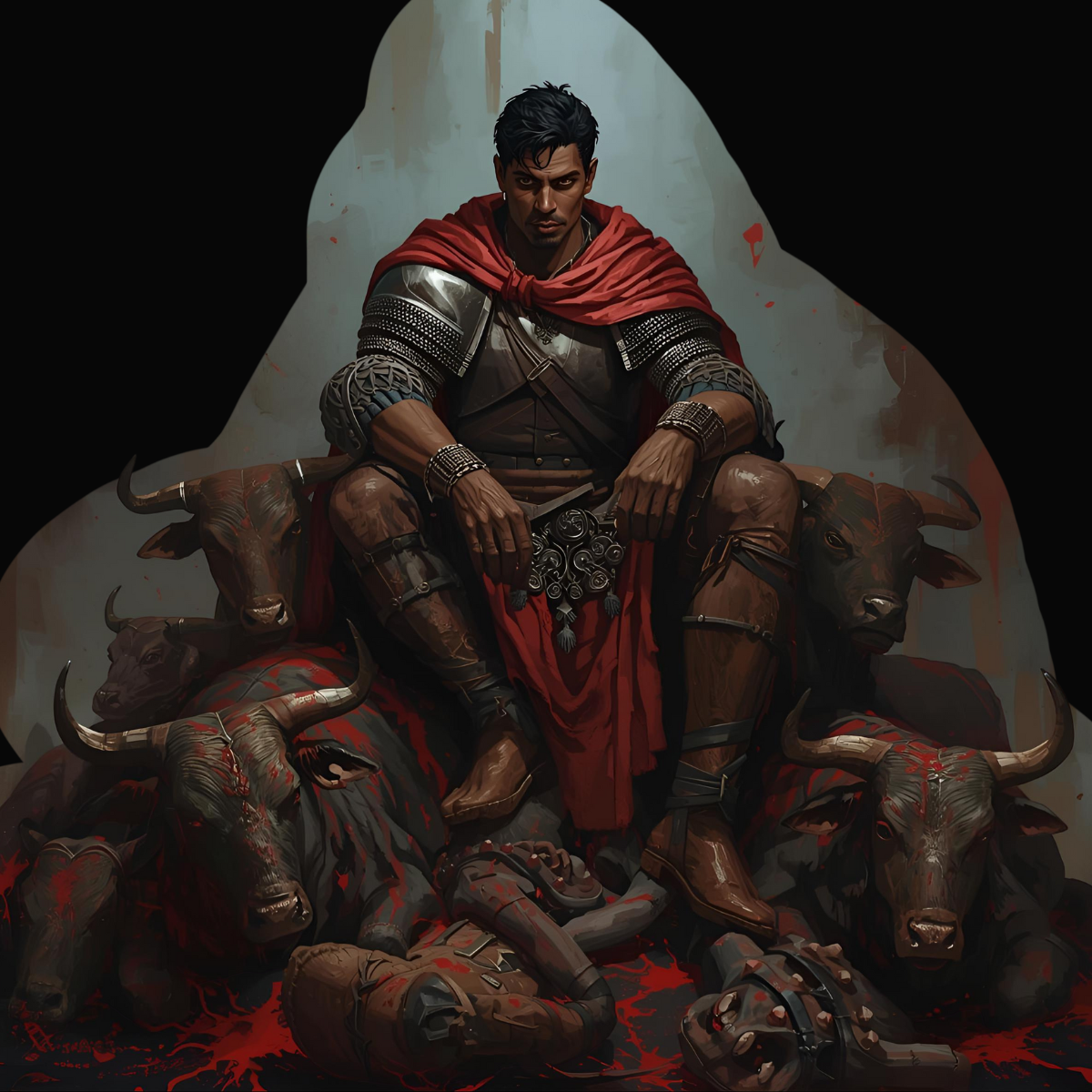
When employers, employees, and leads slog through systems that haven’t resolved its own ghosts, the middle carries the burnout weight. The greatest tragedy is that those who witness it unfold choose silence as survival, while the heroes stand in a trial of fire and insanity. Ajax woke to a pile of cattle; today’s leaders wake to a pile of pings.
What’s critical to note is Odysseus would’ve won on Law and Order too under these pretenses. Let’s recall the case from the story of Martin’s Close: The courtroom in M. R. James’ tale, where a ghost appeared not for spectacle but to demand justice.
A man on trial for murder smirks, sure of his clever defense. *cough* Odysseus *cough*
But in the hush of the courtroom, the ghost of his victim appears.
She does not speak. She does not need to.
Her presence alone demands justice.
The haunting is not the terror of a shadow.
It is the silence that forces the jury to face what was buried.
In Martin’s Close, justice only came when the ghost appeared in plain sight. The courtroom is shaken (only) when the murdered woman’s ghost appears during her killer’s trial. The haunting wasn’t random; it was the reckoning for injustice that had been buried. Yet, Martin silenced Athena with by sharpening the sword of optics against the machine.
Where’s Justice At?

Meanwhile The Judge & Jury, are present as the, formal witnesses, hearing testimony and weighing evidence. The ghost’s presence forces the jury to confront what was buried. The Spectators in Court
Act as communal witness — the haunting becomes public knowledge, not just a private torment. The trial becomes a ritual of silencing accountability. The courtroom hushes at the ghostly interruption and we (the reader) slip into a silent judge and jury too.
The “witness” in Martin’s Close = anyone who sees the haunting and claims it out loud and true. Instead, the reader, in both Ajax and the Close receive,
- A working-warrior wakes in shame among the slaughtered cattle.
- A haunted trial stalls as a ghost stares at the jury.
- A middle manager scrolls LinkedIn at midnight, exhausted, unseen, yet demanded for more.
All three are the same.
So was Ajax’s haunting madness?
Or could the optics no longer hold the truth of Athena’s love of a slow-burn?
Ajax stayed the hero, then he saw the truth: that the system had robbed him of honor, blinded him, and left him wrecked among wasted battles. In our organizations, burnout is that moment. The haunting arrives when the strongest contributors wake to find their labor spent on illusions, their honor denied, and their culture absent. That is the true cost of culture-less growth.
In our organizations, burnout plays the same role. The haunting will not stop until leaders restore what was silenced: culture, belonging, joy. Because growth without culture is always a ghost story.
When culture is absent, burnout fills the vacuum. That’s the ghost in the system.
The tangible costs are clear: productivity loss, hidden rehiring expenses, brand erosion vs the intangible costs — morale, creativity, trust — harder to measure and even harder to restore.
Some systems were designed with rigid parts in mind: checks & balances, assembly-line labor, bureaucracies. The machine feels steady, but “runs,” but like an old factory engine — creaking, inefficient, built on outdated logic. Yet, when trapped into a logic of heroics and optics, the hidden haunt begins to build its case. The result is:
- Tangible cost: Workers stand before systems that crown optics over honor, leaving culture absent and burnout rising.
- Intangible cost: “Creativity erodes when systems encase control outdated logic and win-at-all-costs culture. Just as Martin’s ghost forced a reckoning, burnout forces leaders to confront the invisible debts of culture-less growth.
Yet, Culture isn’t perks or slogans. It’s values our embodied, rituals honored, people aligned.
Think of the parable of the three bricklayers: one sees his task as laying bricks, another as building a wall, and the third as constructing a cathedral. Same job, different culture.
Culture is the infrastructure that turns growth into sustainability. It’s the difference between a machine and an organism — between extraction and evolution.
Millennials run on haunted coffee. We don’t need more slogans; we need a séance of our systems.
👻 In every age, the haunting is the same: Ajax with cattle, Martin with silence, us with burnout. Growth without culture is always a ghost story — one that turns heroes into specters and witnesses into weary jurors. And yet, ghosts only appear because something sacred was silenced. Which means the cure is never metrics, but relief from the memory that binds us.


 Zinga Hart
You must be logged in to post a comment.