one more move sustain small business success

Sustaining Success for Your Self

Howdy! It’s another Monday and this post here is for you!

You know who you are, you are the person striving to realize your vision of success. Yet, success means much more than money to most of us. It is a reality that money is an effective measuring stick of our ability to fulfill goals, it can often be wholly inaccurate when it comes to fulfilling our core desires. You may find fulfillment in your families, friends, plentiful passions, and, most importantly, all of the above. For us, success can be applied to many areas to growth in our lives.

So many goals to be complete — followed by the insistent reminder of the fleeting nature of time. So we make deposit after deposit of our time, money, and energy into our areas of growth.  Then, because we’re human, we take on an ambitious goal. The one that may disrupt our lives immensely and take a risk to build a larger vision of a day-to-day future beyond our current day-to-day grind.

How do we possibly fit it into our current lives? How do we possibly stay motivated to fit it in with our full-time jobs, families, and a host of other responsibilities? There are only so many hours in a day, and your life was full before you set about realizing your dreams of success.

There are a few scenarios we face during a substantive success journey.

  • You are used to managing complex change and fit this new personal risk into your schedule with ease.
  • Your are overall comfortable with managing complex change but find you overlooked areas beyond your limits, and thus are facing a slower growth than you first imagined.
  • You are not comfortable with managing complex change at all, in fact, thinking about it causes a shiver of anxiety. Typically you only think to take the risk and hardly move beyond this comfort zone.

Either of these scenarios can still result in your finding the personal success on the risk you know you must take. While the effort to get from discomfort to ease will vary there are some key points along the way.

Key Point #1 You are the core, captain, engine, leader, etc. etc. 

Albert Bandura’s work on self-efficacy sums up the important role that the Self plays in our ability to succeed. Self-efficacy is essentially our own belief in our own abilities. Much like the story of the elephants who grow up with heavy chains around the ankles. They believe this is the most movement they can achieve when they are on and thus by the time they reach adulthood they can be controlled with nothing more than a rope. Their self-efficacy in their ability to break the chains reaches a low-point and thus they lose a deep connection to the inherent power that lies within them.-source

On a positive end, I recently encountered a touching Facebook post about the story of Edison, who learned from his mother that he was dismissed from school because he was gifted beyond all the other classmates, and then, when his mother passed, years later he later found the note that showed the teacher thought Edison was too dumb for any formal teaching. The lesson distilled is his mother’s beliefs, built his beliefs about his own genius, so, he fully tapped into as much of his potential as possible.

What’s the takeaway?

Your foundation of success comes from believing you can achieve whatever you set out to do. 

Easy to spell out sure, but in action, this key point takes continuous practice. There are many conflicting images, thoughts, and experiences that will run contrary to our beliefs at times. They will attempt to break our beliefs, but the remedy is to find points of faith, whether it’s self-faith, faith in a higher power, or faith in whatever, practice touching base with the future you know will exist.

There are many conflicting images, thoughts, and experiences that will run contrary to our beliefs at times. They will attempt to break our beliefs, but the remedy is to find points of faith, whether it’s self-faith, faith in a higher power, or faith in whatever, practice touching base with the future you know will exist.

Key Point #2 Sustained success comes from systems 

Whether you like it our not, systems achieve a lot for us as humans. Within our body alone we can count over 5 key systems that keep us going, then there’s the road system, the water system, the school system, etc. etc. Organizing actions and activities around shared functions and themes can give us something very, very valuable. That value is and consistency. We can be deeply grateful that a red stoplight means cars will stop or knowing all the words on a spelling test means you will pass the spelling test. Excellent systems function so well we only notice them when they stop function. Consider your computer, millions of calculations are being made and networks are connected for your pleasurable use. Yet, our level of content with the computer working can often be vastly outweighed by our level of frustration should it suddenly stop, even if the computer spent years serving your needs dutifully!

The point is when systems work, we can achieve a lot more, and when systems break down we can face anything from the minute to disastrous frustrations. The takeaway is to pay special care to the how of things: how you do things, how you want to do things, and how you will do things can be key performance indicators on your personal path to success.

Final Key Point: Shift Your Solution Mindset 

You may jump at this one, but trust, I am not saying shift your solution mindset to the opposite non-solution mindset. What we are getting at here is the idea that the solutions you create to solve your current problems may not be the solutions that will help with future undertakings. In fact, the solutions you will need on your success journey may be wildly different than what you are used to doing. For instance, if you are trying to start a small business on the weekends, but are finding there is simply not enough time to do it yourself. How can you possibly do it yourself in between all the commitments? As you ask these questions for your subconscious to solve you may switch to your default solution of doing even more on your own, and staying up waking hours or missing lunches.
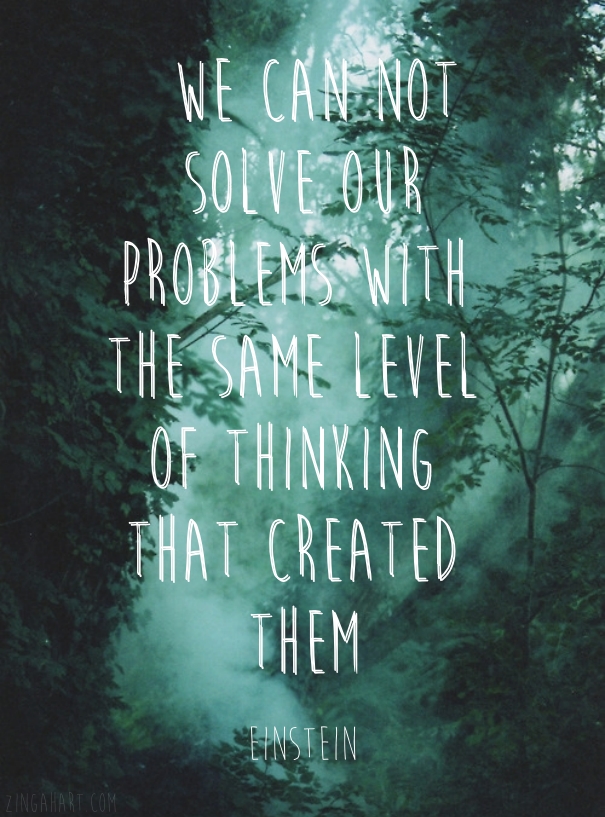
solve problems find success zinga hart quote from einstein - we can not solve our problems with the same level of thinking that created them

Ask yourself, what are other solutions beyond the one I am already thinking?  Our small business owner may question other ways of securing time like: outsourcing easy tasks, scaling back on commitments, or honestly finding current time sinks in their schedule. Even if the alternative solutions you create seem impossible at the moment, finding alternatives will open you up to new possibilities for yourself.

Overview:

  1. You can achieve your success- Find ways to remind and affirm this belief.
  2. A system will allow you to sustain success long-term
  3. Systems that aren’t currently serving you may need vastly different solutions. Draw outside of your normal solution lines.

Well that’s all for this post. Let me know if agree or disagree. You could always message me on Facebook.

clarity on social media marketing for small business shows a clear windshield with a dream catcher

Clarity is Imperative For Sustained Success


The Law of Entropy. My chemistry professor used to joke entropy was to blame for his messy office.

It’s bound to happen, our persistently organized systems will break down…

Despite our best efforts to build better and better systems, there will always be room for improvement because our systems will eventually encounter a chip, glitch, or setback.

This universal pattern explains why as we try harder and harder sometimes it feels like we find more moments of failure, more than when we didn’t even try at all.  Perhaps we can even give it the term the law of effort: mo’ money, mo ’problems in a sense. It’s why we entrepreneurs are always reminding each to keep hustling and to take one more risk.

You may consider to yourself: what does it take to make sure as we attain new heights of success on our journey? How can we ever continue when we feel the blows of betrayals, letdowns, and disappointments?

One key practice is making sure we are crystal clear about what moves us forward and why we choose to move forward.

It is imperative we keep crystal clear about what moves us forward and why we choose to move forward. @ZingaHart 

Stepping back to unfog our vision’s lens every once in awhile is as relieving as cleaning your car’s windshield. The tension of life’s muck provides a subtle added negative stressor from the strain of trying to see as far ahead as we know we can. So we take a moment to wipe it away, and then we see what we know we have the potential to see. A brighter vision of the road ahead of us.

How do you wipe the subtle stressors that slowly attach to your success goals over time? Do you meditate? Journal? Or perhaps simply unplug? Comment below or share with me on social media somewhere 🙂 

For me, my current long-term project is developing workshops to help small business owners gain social media clarity. Writing this for me takes a lot of concentration and energy, and having a clear strategy helps take the stress of thinking away. When I don’t feel like I know what to do next, I know to defer to my past notes for inspiration, and motivation. No matter what, if you are fighting through a mental fog at any point on your success path: slow down, reflect, and clarify. The next step will open up when your insight can relax on your vision again.

If you are building a social media strategy as a part of your success plan, you should sign up for the 10-day social media clarity challenge.

Go from chaos to clear in just 15 minutes a day – delivered straight to your inbox.

Sign up here for free or sign up below. This is nothing fancy, just simple action emails to keep you moving forward. Do this for your personal brand or your business. Challenge starts May 1st. 

← Back

Thank you for your response. ✨

micro moves to focus fast get productive improve success

7 Micro-Moves To Focus Fast w/ 3 Free Bonuses

Do you get off track easily?

From time to time, you may find that distraction is winning  a lot of battles in your fight to stay motivated and push towards your success. Whether it is building your personal brand, building a business, or achieving any other goal, there is a key to staying focused and persistent.

From time to time, you may find that distraction is winning  a lot of battles in your fight to stay motivated and push towards your success. Whether it is building your personal brand, building a business, or achieving any other goal, there is a key to staying focused and persistent.

Luckily, there are simple, and free, ways to quickly  get back on the priority task at hand instead of logging another hour mindlessly scrolling Facebook to do…”research” . While these moves can be done alone, they also work together in a sequence. Use them as a quick routine when you realize that your are avoiding your valuable tasks for an unproductive ones.

MicroMove  #1 Take a deep breath

If you are losing focus on a task you know you have to finish, then there is probably something about that task that causes you stress. This stress triggers your “fight/flight” response which turns you to your coping mechanism: distraction.  This subtle behavior is rewarded with the removal of the stress, which is a positive outcome and so you are not easily persuaded away from your flappy bird marathon because it feels better than writing a 10-page marketing piece or presentation for your big pitch night. Whatever it may be, struggling through the cumbersome and complicated process that is reaching long-term success comes with no guarantees. Meanwhile, your favorite reality show comes with a very real and very now satisfaction.

That is why taking a deep, and I mean, deep breath is a micro behavior to first take when you truly want to disrupt the pleasure vortex. According to a Harvard Family Health report, deep breathing triggers us to relax, which releases the stress sensations that were eliciting the fight/flight response in the first place. So, if you wanted only one more move to help you get focused fast then you can stop here. If not, keep going…

MicroMove # 2  Check the Time

Sometimes a project is really stressful…

Honestly, you just know it is going to take forever and you have an entire to-do list to get through, plus the day is just etching away…

These are thoughts that definitely run through my mind if I feel as though I am distracted through the day. How are we supposed to fit so many priorities into such an infinite amount of waking day?

Often, when this happens, I find I really don’t know the exact time. How much day do you really have ahead of you?

By checking the time you afford yourself an opportunity to make a rough sketch of how all of what you want to do can play out, and if you are short you are forced to prioritize to the essentials.  This helps focus you in relationship to your present situation.

Once you know how much day you have ahead of you, pick a priority for every 1-2  hours left.

MicroMove # 3 Set a Timer

So you are feeling less stressed and prioritized, but stiiiillllll…..getting started on that project isn’t any more motivating. No matter how calm you are or how important you rationalize it to be, the energy to get you going just isn’t sparked. So what to do next?

Set a 10 or 20-minute timer to complete the first priority. Set the timer before you are even sure what you want to do next. This creates an external incentive to commit a small amount of time to devote from the time you have left.

By incrementing time even further, you’ve placed bite-sized boundaries on this once insurmountable project.

MicroMove #4  Check Your Goal or Write a Goal

Next if you don’t already have one, set a goal or check a goal. For example, I have a command center that I created a while ago, which lists my major priorities. Helping grow a non-profit, developing my business, and contributing to the higher education profession are the top three. From there I would pick one for the next hour or two and I would work on one goal.

For someone writing it may be to write a chapter, edit a chapter, research 10 sources. Whatever it may be, make sure your goal contributes to advancing your priority.

MicroMove #5 Make sure your goal is SMART

One of the things that trips me up, is sometimes the goals I write are not easily processed by my mind. I teach this in many goal setting workshops. Our minds are very much like programs processing lines of code and interpreting it into action.

If I set a goal that is something like : “Create packet”

When I return to complete the goal, I can be completely oblivious to exactly what the parameters of packet creation will be. Furthermore, if it is an older goal , I may complete lose why and what I wanted when I wrote “Create packet”.

So it helps to make goals as specific as possible, and the SMART acronym is a tool used to refine your goals into a way that we can process easily.

“Create packet” becomes “Make a rough draft of a 3-page marketing packet for our latest workshop offering on MeetUp within the next 17-minutes (your timer is still going).

MicroMove #6 Say an affirmation

Affirmations are a simple way to promote positive thinking around your priority project.

Great affirmations for focus:

  • I have all the time I need.
  • My work is a priority and I work my priorities.
  • Staying focused is easy.

Here are some more great affirmations for focus. Just pick one though and move on to your final move.

MicroMove #7 Do it

Jump in there! You have reduced stress, prioritized, specified, and affirmed! There’s nothing left to it but to do it no matter how unpretty it may be. Get in there and get it done. The clock is ticking.

Bonus moves

  1. Always be aware of your triggers – Brainstorm a list of triggers and build your  awareness by noting when you are engaging in a trigger. Playing Call of Duty when you know there are chores to complete or diving into an hour-long debate to avoid finishing that first draft. Gently note this times and realize you can take the micro moves above to get back on track.
  2. Write if-then statements and keep it nearby – If then statements are great tools to use with your awareness of distraction triggers. For instance at an old job my boss had us all say the motto “If there is time to lean there is time to clean” – plug in your trigger with your priorities and use it as a verbal reminder to refocus using some of the moves above.
  3. Have a reward system handy – When you do get back on track and finish your work in the time you devoted know of 1 or 2 rewards you can give yourself a positive experience and reinforce the satisfaction of being focused.

The smallest steps lead us toward success. When you recognize that the small moves that you take contribute toward your overall achievements your destiny becomes much richer and simpler. You can relish in every note you write and every goal you set which will keep you motivated in the long run. Appreciate your micro moves and use them to keep them keep you focused today.

For more moves toward your success visit zingahart.com or email me at zingahart@gmail.com to discuss a personalized strategy for you.

strive to build trust with social media at zingahart.com for ohio women leader group

Strive to Build Trust With Social Media

I joined the Kent Young Professionals leadership council’s marketing committee recently. Of course, having the chance to lend my expertise to building something from start-up phase is an experience I hold dear. What do you jump at the chance to experience?

Knowing what I’ve acquired after many years of promoting, managing, and strategizing for social media growth, I would strongly advise, anyone travelling into the social media marketing journey to put building trust at the center of the strategy.

Social media is like the force, while powerful, when it is used for good it is good, but when it is used for devious purposes it can cast a shadowy, ugly spirit-crushing light for anyone who dared to trust an appealing link or headline. Customers are aware of the stalker-like practices of ads and the false promises of online shopping and services. The quantity available to them is like a tidal wave, and many of us are cutting off our engagement to keep from drowning. On the business end, our potential audience reach is too as rich as the ocean with cohorts of diverse people, personalities, and personas that we can try to attract. Like two waves, a general strategy will only cause a crash of chaos.

So how do you build an online relationship, especially when you are starting from the bottom?

Start with trust.


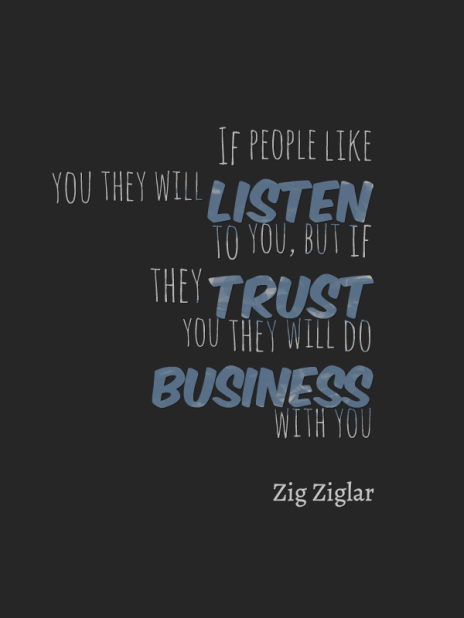
build trust quotes zingahart - if people like you they will listen to you but if they trust you they will do business with you

Like any relationship, we open ourselves up to be vulnerable by relying on someone or something else to provide the value we need. On both the client and business end, we need to be able to identify the value, while validating reliability. Social media benefits when you focus on providing those two metrics.

As a move to incorporate into your trust into your social media success strategy, reflect on these questions:

  • How is building trust a part of your social media strategy?
  • What ways are you ensuring people can learn to rely on you (or your business)?
  • What guarantee can you commit to providing?

Have you ever been burned or betrayed by an online promise? What could they have done to make the exchange go right? (Comment below 🙂 


Keep Your Brand On-Point this year NYC

4 Smart Steps to Keep Your Brand On-Point this Year

If you are up to date on the latest trends in growing your reach online, whether it is for yourself, business, or passion then you know cultivating your leadership brand means creating content for the web. Content is valuable, purposeful, creations (whether an article, video, comic, podcast, etc.) that attract a particular audience and ultimately drives them to take action.

Yes, all those infographics, quote pics, even random Twitter rants you post are tied to the web of your brand. In a sense, this becomes the pre-impression before the first impression someone might get from meeting you more personally. In a sense it also forms an idea of who you are and a baseline for the value you bring to the table that people can start to believe. 

self authorship zinga hart - Quote is Our Self Image, strongly held, essentially determines what we become

Can you visualize your self-image clearly?

While your integrity is usually tested in real life, your reputation is partially set on the foundation of what you post online. While you don’t have to be a prolific author to write your story, you do need to respect how critical it is to maintain your authenticity, while growing your personal or business brand. Self-authorship is a theory attributed to Baxter Magolda, and is defined as “the internal capacity to define one’s own beliefs” as she wrote in Three Elements of Self-Authorship. This self-definition is at the foundation of developing your personal brand over the course of your success journey. Owning your beliefs takes time because you need to sort out the wealth of information you have absorbed and learned over a lifetime and distill it into your core sense of being. While, not quick task, with simple steps you can begin to dig in deeper, find your internal sage and use that to project and share your brilliant brand with the world in a way everyone can agree upon.

Here are four simple steps to author your self-definition so you can grow and polish it over time.

  1. Journal on what you think you have to do in order to fulfill your dream life: What are the essential things you need to live. Be specific: “Using the bathroom, eat, sleep” are some basics to include, but keep adding until you’ve exhausted your ideas, “own a business, have a family” could all be a part of this list.
  2. Walk away from the list for a day or so and then return. Look over the list and question how this master to-do list aligns to your values, your mission, and your vision. If it doesn’t click, make a note of how the “have to” came into your life. For instance, if you wrote, “own 20-bedroom mansion like Oprah” but your vision is to travel for the rest of your life, then consider Oprah’s role in influencing your personal beliefs.
  3. This working list is for you to return to and to refine over time. Choose the strongest beliefs of the work you have to do to live a full life. Notice what comes up over and over, notice what you are most proud of as you go about your days. Reduce your have to four or five sentences to keep your essentials close.
  4. Own it. Write it out, make it your screensaver, or create a ringtone. Figure out a way to keep your essential commands to yourself a constant in your life.

There are easy steps on the road to self-authorship Of course, there are many more steps on this journey, from vlogging to therapy, but what matters most is getting started. Thanks for walking with me!


For more here’s a Youtube video on the four phases of self-authorship

Want a partner to help you hone in on your self-definition?

Set up a free phone chat with me here!

From Passion to Process: 1st Workshop of the New Year!

I had a ton of fun today at Scribbles in Kent, OH. I hosted a workshop titled from Passion to Process where we reflected on our passions and then set aside time to build a system towards enacting our passions on an annual, monthly, weekly, and daily basis. It was a blast and such a good feeling to hear it was a helpful session.

northeast ohio passion discovery

Bonus: Scribbles is awesome and I thank them for hosting us! Their wall is lined with books and getting to color on the table tops was a creative feature.

passion discovery worksheet

One part I was particularly proud of was transforming my personal at-home command center into a useful printable for everyone that attended. The full version of the 2016 Command Center is attached below. I condensed it to one-page from them to save on printing costs and paper, so I wanted to share the full-version should there be any visual types out there.

Screenshot 2016-01-09 at 10.09.20 PM


Grab the free full version printable 2016 Command Center today.


Daydream to Boost Your Most Passionate Career Path

96% of adults daydream. If you are one of those adults, ask yourself: are you using this seemingly random activity to the fullest potential?

Like most successful activities, daydreaming to your favor will take practice, purpose, and persistence and, in this case, we’re going to focus on your career. How can you use daydreams to ensure you are reaching your career path’s most passionate potential? There are simple techniques to do so, but first a short overview of current thoughts around daydreams. 

What are daydreams?

Daydreams were discovered when scientists notice neural network activity while participants were not participating in anything at all. This came to the formation of the phrase “stimulus-independent thought,” which are thoughts created sans interaction or engagement with the environment outside of our minds. In this sense, daydreams may seem as if they are out of your control, and they can easily be, but the truth is our mind is a muscle and we work with it as we would most functioning muscles in our body.

So how can we use daydreams to create our best career path?

We must actively practice day dream by engaging in personal discovery sessions. This type of daydreaming is called positive-constructive daydreaming, which is the active reflection on our feelings, thoughts, imaginations, and other personal facets of our life in an open manner. This activity means letting go of any urge to stop yourself from thinking a thought or dreaming a dream. Studies found  this type of thinking led to an overall sense of well-being and furthermore it opens you up the possibilities of where you can apply your value.[source]

envision your career success

How can you use this on your career path?

 The answer is there are many ways to do it and you mustn’t stop at one! Experiment and continuously reflect on your career path throughout the time that you desire to earn a living for yourself. Two simple ways to incorporate this technique into your life is by:

Take a career quiz

Taking personality quizzes, like this one, or this one, and imagining yourself in the ideal roles that they describe for you. When it comes to career construction, my old mentor, Dr. Mark Savickas, told me they’re only about half right. Yet, this is a safe and simple activity to envision a future you.

Put yourself into the position and research it. Note what excites you and what doesn’t as you explore what the role has to offer.

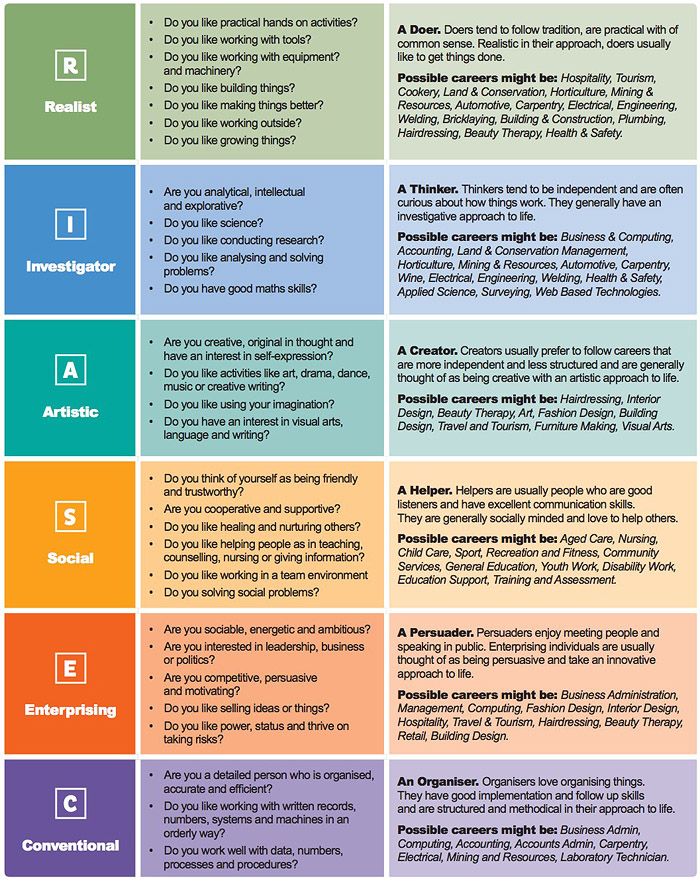
The closest personality test for your work preference is the Holland Code, a model developed by John Holland and used by the military. My Holland Code was IEAS, most Holland Codes are the first 3 letters, which meant my career preference would be book restorer. NO!!! Don’t let online or even legitimate quizzes decide your career path,  in order to find your authentic value you must dream deeper into who you are.

093fbcd5dd89bba56915457eaf1a17fa

Career Path Dream Land

Asking yourself probing questions and then answering them until you reach a point of profound clarity is a thing. This is what is needed to really unearth the answers of who you are and where you are meant to bring value to the world.

A safe way to do this is what I call a mini-self-retreat. Find a way to get time alone and comfortable: send the roommate or partner out, find a baby or pet sitter, or go to a hotel.

Relinquish yourself from responsibility save for your Self.

Then have a nice thoughtful internal discussion about what you want. Stay with the discussion and record your answers for later use, listen to yourself with openness and innocence, as if within you there is a great warm source of your very own personal all-knowing. It can seem different at first, but this is just a surface level way to find your authentic value from within.

Will daydreaming get you a job? No. Constructive daydreaming and self-discovery will set you on a path to a career you are confident carrying as a part of your life’s legacy. If that’s something you think is worth having, let me know!

Comment and we’ll connect 🙂

No affiliate links in this post.

5 Small Steps to Create and Use A Personal Strategic Plan

Anyone who knows me, knows I love planning. While, I do a lot of business and marketing planning for others, my true passion for planning stemmed from personal development planning. It all sparked from a meeting with Sheila Palmer, Assistant to Donna Karen of DKNY, she shared with me a book called the 7 Habits of Highly Effective Teens after a brief conversation on the beach of Coney Island. When I read that book, the life of discipline, value, and achievement opened up to me for the first time.

From that year (2004) and on, I began a tradition of sitting down every year and creating a personal strategy for the next. This personal strategy helped me get three degrees, start 2 businesses, and accomplish many other complicated goals over my lifetime. Now as I grow into an adult millennial, this tool is helping me manage the many balls in my life with my chill and confident attitude towards getting things done.

First a few notes

  • A personal strategy is your strategy. Only you can define the desires that swell within you.
  • Your strategy will get better with each pass. You have to stick with it.
  • Your strategy can, will, and should change. Although, your values, goals, and beliefs will be closer to a constant, how you reach these ends will need to be adjusted as the year unfolds.
  • Your higher-order mission, vision, and values should remain constant, but be refined over time.

No strategy should be set in stone; it should only serve you for as long as it helps you reach your goals.

So, here are 5 small ways to create and use a personal strategy for 2016 today

  1. Start with your wildest vision for your life then scale it back to achieve for the year. Be a firm believer that whatever goal you set can be accomplished, then do yourself a favor and give yourself a generous timeline to get there. No city is built in a day, but it is built eventually. 2_zkbkpa
  2. Write 3-5 goals to achieve over the year. Try to build off the work you’ve done last year. If you are starting from scratch, make one goal something you can achieve right away to boost your efficacy in achieving annual goals.
  3. Schedule a time to review your goals for at least 5 minutes a day. I know an hour once a week may seem like more, but the odds of missing one week, then the next, then the next, are too high of a risk for your best you in 2016. Instead, find some way to incorporate your visions and goals in a high-frequency place throughout your day. Build it into your passwords, set up a vision board, or make it a part of your alarm clock. There are tons of ways to make your goals presence known.
  4. Pick one goal per day. Yes, you are a leader and have so much more to offer the world, but if you are having trouble genuinely sticking with the goals most important to you then you have to stick with tactics that work. Focusing on one goal per day will not overwhelm your schedule. 5778ca76b341bfa7e1fcaaca85770d4c
  5. Share what you are doing with an accountability partner. Find someone in your life that you admire for achieving their goals. Meet with them and share your goals and work towards meeting with them regularly. Do a SWOT assessment, share tips and tricks, and other successes with them. Sharing your goals makes you more accountable to yourself and others, which will build your persistence.

Simple steps, but a great start to mapping out your best 2016. Let’s get rid of resolutions and map out the business plan for your careers!

What’s wildest dream are you working on? 

Relish Every Achievement. Celebrate Your Success As an Entrepreneur or In Your Career Path To Victory. Be authentic by remembering the small parts.

Relish Every Achievement in 5 Easy Moves

One of my clients is a visionary. Her passion for setting bold goals and creating constant possibilities to current situations is thrilling.When we meet, I find sometimes she feels discouraged by all her organization has not achieved, and quickly overlooking all the small victories she did accomplish. She isn’t the first person I’ve known to do this, and at times, I’ve been guilty of getting discouraged about where I am not instead of remembering and celebrating how far I’ve made it. 

ee3c4f6e9b7b90e6586ba013bc512117

So for our next move forward, we’re going to take a look back on how far we’ve made it.

Here are five ways you can relish your achievements today.

  1. Think of 3 ways you have grown in the past five years. Remember yourself from five years ago. You probably made mistakes, struggled to achieve something, or achieved something that made you proud. Consider this growth. If five years is not enough then think over the ten past ten years. You graduated, got that job, started a blog or business. Take a historical scan of your past and thank yourself for taking those successful steps.
  2. Check off parts of your vision board that you have lived. I had on my vision board to be bold and hang with the best. This year I’ve met more CEOs, executive directors, and other business leaders than ever. What is on your vision board that you find is a quality you are currently exhibiting? The point of a vision board is to help us define our desired reality. When you begin to live those desires you have acted in successful alignment with your vision, so take the time to celebrate. Don’t have a vision board? Make one.62953990
  3. Go through your social media and celebrate your successes. Visit your Facebook page, LinkedIn account, or other social media channel and look for a time where you posted something you were happy about or found to be a particular achievement. Tell yourself good job again and remember that you have been successful in the past and are on the right track. Can’t find anything? Then think of a moment where you shared good advice that someone liked. There, you made an impact, which is a successful action.
  4. Remember something small you did successfully and do it again. If you are having a hard time remembering an significant successes then think every smaller and consider the daily achievements we make. Did you remember to take the garbage out on time? Or call your mother after you set the goal 3-weeks ago? These little acts are acts of success and worthy content to from when your memory banks feel fuzzy.
  5. Share your goal/purpose/mission. Celebrate. Taking ownership of our success means being able to be held accountable. When you share what you want to do with another you have taken a victorious step towards being more accountable, while improving your path to your long-term achievement. It’s a win-win move that you can use anytime.

Celebrating our successes over time is just as important as learning and growing from our failures. Both success and failure keep us humble and motivated on our personal or entrepreneurial success path.

How do you find time to celebrate your success? Comment below or Connect with me on Twitter, Facebook, or LinkedIn