Daydream to Boost Your Most Passionate Career Path

96% of adults daydream. If you are one of those adults, ask yourself: are you using this seemingly random activity to the fullest potential?

Like most successful activities, daydreaming to your favor will take practice, purpose, and persistence and, in this case, we’re going to focus on your career. How can you use daydreams to ensure you are reaching your career path’s most passionate potential? There are simple techniques to do so, but first a short overview of current thoughts around daydreams. 

What are daydreams?

Daydreams were discovered when scientists notice neural network activity while participants were not participating in anything at all. This came to the formation of the phrase “stimulus-independent thought,” which are thoughts created sans interaction or engagement with the environment outside of our minds. In this sense, daydreams may seem as if they are out of your control, and they can easily be, but the truth is our mind is a muscle and we work with it as we would most functioning muscles in our body.

So how can we use daydreams to create our best career path?

We must actively practice day dream by engaging in personal discovery sessions. This type of daydreaming is called positive-constructive daydreaming, which is the active reflection on our feelings, thoughts, imaginations, and other personal facets of our life in an open manner. This activity means letting go of any urge to stop yourself from thinking a thought or dreaming a dream. Studies found  this type of thinking led to an overall sense of well-being and furthermore it opens you up the possibilities of where you can apply your value.[source]

envision your career success

How can you use this on your career path?

 The answer is there are many ways to do it and you mustn’t stop at one! Experiment and continuously reflect on your career path throughout the time that you desire to earn a living for yourself. Two simple ways to incorporate this technique into your life is by:

Take a career quiz

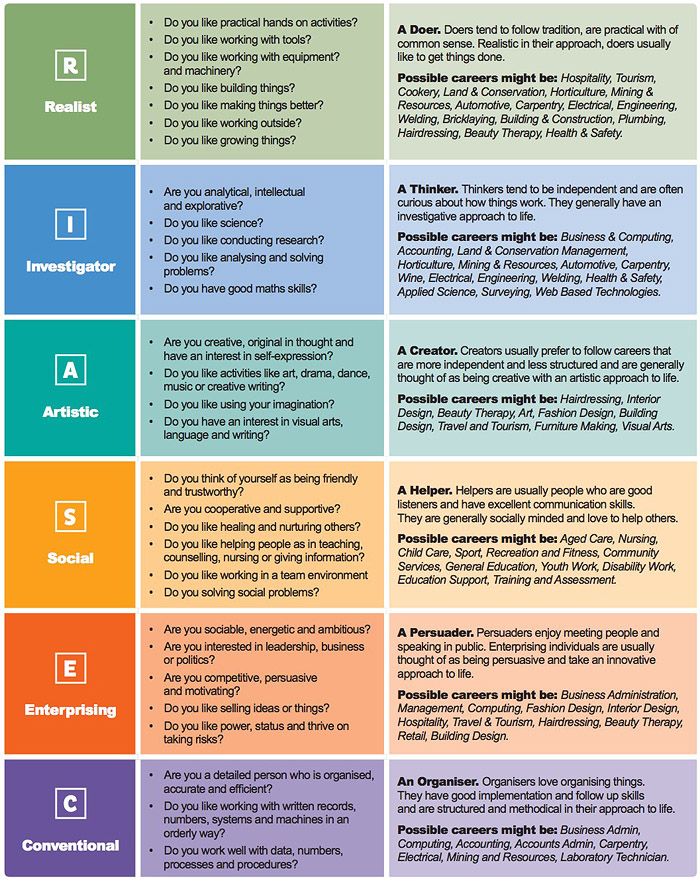
Taking personality quizzes, like this one, or this one, and imagining yourself in the ideal roles that they describe for you. When it comes to career construction, my old mentor, Dr. Mark Savickas, told me they’re only about half right. Yet, this is a safe and simple activity to envision a future you.

Put yourself into the position and research it. Note what excites you and what doesn’t as you explore what the role has to offer.

The closest personality test for your work preference is the Holland Code, a model developed by John Holland and used by the military. My Holland Code was IEAS, most Holland Codes are the first 3 letters, which meant my career preference would be book restorer. NO!!! Don’t let online or even legitimate quizzes decide your career path,  in order to find your authentic value you must dream deeper into who you are.
093fbcd5dd89bba56915457eaf1a17fa

Career Path Dream Land

Asking yourself probing questions and then answering them until you reach a point of profound clarity is a thing. This is what is needed to really unearth the answers of who you are and where you are meant to bring value to the world.

A safe way to do this is what I call a mini-self-retreat. Find a way to get time alone and comfortable: send the roommate or partner out, find a baby or pet sitter, or go to a hotel.

Relinquish yourself from responsibility save for your Self.

Then have a nice thoughtful internal discussion about what you want. Stay with the discussion and record your answers for later use, listen to yourself with openness and innocence, as if within you there is a great warm source of your very own personal all-knowing. It can seem different at first, but this is just a surface level way to find your authentic value from within.

Will daydreaming get you a job? No. Constructive daydreaming and self-discovery will set you on a path to a career you are confident carrying as a part of your life’s legacy. If that’s something you think is worth having, let me know!

Comment and we’ll connect 🙂

No affiliate links in this post.
5 Small Steps to Create and Use A Personal Strategic Plan

Anyone who knows me, knows I love planning. While, I do a lot of business and marketing planning for others, my true passion for planning stemmed from personal development planning. It all sparked from a meeting with Sheila Palmer, Assistant to Donna Karen of DKNY, she shared with me a book called the 7 Habits of Highly Effective Teens after a brief conversation on the beach of Coney Island. When I read that book, the life of discipline, value, and achievement opened up to me for the first time.

From that year (2004) and on, I began a tradition of sitting down every year and creating a personal strategy for the next. This personal strategy helped me get three degrees, start 2 businesses, and accomplish many other complicated goals over my lifetime. Now as I grow into an adult millennial, this tool is helping me manage the many balls in my life with my chill and confident attitude towards getting things done.

First a few notes

  • A personal strategy is your strategy. Only you can define the desires that swell within you.
  • Your strategy will get better with each pass. You have to stick with it.
  • Your strategy can, will, and should change. Although, your values, goals, and beliefs will be closer to a constant, how you reach these ends will need to be adjusted as the year unfolds.
  • Your higher-order mission, vision, and values should remain constant, but be refined over time.

No strategy should be set in stone; it should only serve you for as long as it helps you reach your goals.

So, here are 5 small ways to create and use a personal strategy for 2016 today

  1. Start with your wildest vision for your life then scale it back to achieve for the year. Be a firm believer that whatever goal you set can be accomplished, then do yourself a favor and give yourself a generous timeline to get there. No city is built in a day, but it is built eventually. 2_zkbkpa
  2. Write 3-5 goals to achieve over the year. Try to build off the work you’ve done last year. If you are starting from scratch, make one goal something you can achieve right away to boost your efficacy in achieving annual goals.
  3. Schedule a time to review your goals for at least 5 minutes a day. I know an hour once a week may seem like more, but the odds of missing one week, then the next, then the next, are too high of a risk for your best you in 2016. Instead, find some way to incorporate your visions and goals in a high-frequency place throughout your day. Build it into your passwords, set up a vision board, or make it a part of your alarm clock. There are tons of ways to make your goals presence known.
  4. Pick one goal per day. Yes, you are a leader and have so much more to offer the world, but if you are having trouble genuinely sticking with the goals most important to you then you have to stick with tactics that work. Focusing on one goal per day will not overwhelm your schedule. 5778ca76b341bfa7e1fcaaca85770d4c
  5. Share what you are doing with an accountability partner. Find someone in your life that you admire for achieving their goals. Meet with them and share your goals and work towards meeting with them regularly. Do a SWOT assessment, share tips and tricks, and other successes with them. Sharing your goals makes you more accountable to yourself and others, which will build your persistence.

Simple steps, but a great start to mapping out your best 2016. Let’s get rid of resolutions and map out the business plan for your careers!

What’s wildest dream are you working on? 

One More Move - Sounds out the word omm which is a common chant in yoga

One More Move: Give Gratitude

Back to our regularly scheduled One More Move article! This series gives you singular moves to keep you motivated, authentic, and connected as your grow you personal and career path. This week, I challenge you to express gratitude. Why? Because it is through this expression of gratitude that we heighten our life’s quality, elevate our mood, and build our interpersonal relationships with others.

The benefits of gratitude are immense. It affects our mind, body, and soul. Below is an excellently designed infographic on The Power of Gratitude. You can see how the power of gratitude can help you can gain more energy, get better sleep, be less anxious, and have fewer headaches. All these benefits are necessary to regulate in order to stay motivated on the long-haul to your legacy. In a sense gratitude is the attitude of leadership that keeps us going and connected to ourselves and others around us. How do you find gratitude through out your day? 

12 Steps to Thrive

Credit Thanksgiving Infographic from Mind Valley Academy.

Here 5 easy ways to express gratitude today!

  1. Write a recommendation on LinkedIn  
  2. Send a thank you card to a colleague
  3. Give a generous tip to your server
  4. Publicly thank someone on Facebook
  5. Handwrite a letter of appreciation to a mentor your admire

Tiny Buddha offers 50 unique ways to express gratitude, which focuses a lot of being fully present with others  and considering ways to truly touch another person as a leader. There are many places where we can express gratitude. When we take time to make this one move we ripple forward positivity and good vibrations.

To cap off, here is a TED Talk on the Transformative Power of Gratitude. Give gratitude fair value as your return on investment is worth the deposit.

Want success control time. This shows a clock falling to the ground to show a sense of time being out of control

Want Success? Wield the Tool of Time!

Want success control time. This shows a clock falling to the ground to show a sense of time being out of control
photo credit: 12 sec via photopin (license)

Do you want to move forward in your career, manage multiple projects with ease, drastically reduce stress levels?

You may be wondering how can I take control of my time?

What we know about time do know about time? Scientifically we are still inconclusive. Early theories related time to the breakdown of things; the collapse into chaos. The theory behind the relationship between time and energy show that with time dormant energy will move velocity and acceleration at a constant rate. Although what time is exactly is still fuzzy to definitions science agrees it plays an important role in the things that happen and perhaps even the creation of the universe.

Yet, with all the studies surrounding time Carrol claims it is “not the be found in the underlying laws of physics” Time does not take up space and does not have a mass. Which in a sense means time is a imaginary. It’s not a real part of our physical world, but one created by us humans. It is hard to pin down this tool we created. Major philosophical theorist divide into three parties: Presentists, Growing-past philosophers, and eternalists. Presentists believe on the present is real. Growing-past philosophers believe the past and the future are real and eternalists believe in the existence and reality of past, present, and future. I lean towards the eternalist camp. I think most entrepreneurs do, since the future is the substance of our dreams.

Time is more valuable than money quote

Which is why “time is money” is the mantra of any wealth warrior. Recorded in The Free-Thinker in 1719, the phrase time is money relates the idea that time is a valuable resource as one of the purest measures of human value since our time is finite on this earth and we must produce what we best can and seize opportunity. Are you leveraging your time to maximize your return? Wasted time is wasted money and it moves you further away from the feeling of success. As though you are not maximizing the opportunities available in your life. How can we escape the subtle sense of chaos that comes with time?

We have to focus on what is really at play. You have a desire to effectively seize the opportunities you have before you. Time-management needs to be re-named to Self-management. Self-management is “the process of evaluation [sic], prioritizing, and organizing one’s tasks” . Time is the imaginary tool we use to measure the movement and completion of tasks. We watch a flower grow and a forgotten yogurt die. When we use the tool of time right we realize the steps we are taking towards our goals. When we use the tool incorrectly, we can dwell in non-present aspects of time like stressing over the future or reminiscing in the sweet past.

How do you manage yourself wisely? The first step is to put yourself first. Self-management is a continuous process of a commitment to developing yourself. It took me ten years to get a comfortable grip on time, and I’m still striving for greater discipline. What major roadblock in my way, was the belief that if I just gave my mind, body, and spirit up to other things I would somehow feel fulfilled with the time I was spending. So I worried unnecessarily, ate indulgently, and felt all types of ways without making any real traction in my goals. It was only when I focused on myself: being my healthiest; cultivating my thoughts for pro-action; and rewarding my behavior with gratitude and respect that I suddenly began to take leaps towards achieving the life I desired.

Practice items

Here are some reflection exercises for self-management:

  • What do your value? How do you rank your values?
  • What are your top 20 priorities? Drop it down to 5.
  • What does it take for you to perform at your best?

Sign up for the free e-Mail course! 5 days to Confidence with Time Series releasing August 17th

References 

Time and Energy – Millennium Relativity.” 2002. 5 Aug. 2015 <http://www.mrelativity.net/TimeEnergy/TimeEnergy.htm>

What Is Time? One Physicist Hunts for the Ultimate Theory …” 2014. 5 Aug. 2015 <http://www.wired.com/2010/02/what-is-time/>

“Time | Internet Encyclopedia of Philosophy.” 2009. 5 Aug. 2015 <http://www.iep.utm.edu/time/>

“What is the idea behind the quote “time is money”? – Quora.” 2014. 5 Aug. 2015 <http://www.quora.com/What-is-the-idea-behind-the-quote-time-is-money>

“Time = Money | SUCCESS Magazine | What Achievers Read.” 2013. 5 Aug. 2015 <http://www.success.com/article/time-money>

“Time Management – Exploratory Studies at Purdue.” 2014. 5 Aug. 2015 <http://www.purdue.edu/exploratory/academic-support-new/time-management.html>

Management: Developing Self-Management Skills … – SQA.” 2007. 5 Aug. 2015 <http://www.sqa.org.uk/files_ccc/CB3496_self_management.pdf>

Valuing people hurts your bonds

In preparation for a workshop I was going to give, I ended up doing a value identification exercise.

quarters balancing represents value and teamwork

It was then I realized the names of the important people in my life: my husband, daughter, and other family members did not pop up.

Part of me felt obligated to write them down on my list, but my mind kept calculating that this connection was off. After reflecting for a bit, I realized that value should only be placed on objects, actions, and ideas. For instance, my husband is priceless and, therefore, invaluable. Now his influence skills, care of his family, and trustworthiness are actions and qualities I have come to value during our relationship. His being as a person was never something I could weigh against any human measurement of value.

When we value others we equate them to commodities. Whether it is positive (Jenny a valuable member of the team) or negative (Rich wasn’t worth a dime) we lower their potential and limit their possibilities to imperfect human measurements. Finally, we subject ourselves to the possibility of measuring our worth with money, possessions, or other human values. Karl Marx, a philosopher who studied weaknesses in the purely capitalist society, noted the concept of commodity fetishism or measuring social relationships by their usability or where the object is valued in place of the work behind the object. A lot like reality celebrities Hollywood glitz and glam supersedes the low-budget, low-quality content produced on reality TV shows.

So when relating with others, build a stronger connection not by valuing them for who they are, but seek, find, and appreciate the value of what others do. How do we relate to others in a positive way without placing value directly on the person?

Consider all of the other ways we can relate. 

For instance, I love my husband, care deeply for my daughter and value the trust I share with my sister. There are so many other ways to connect our beings to another without demoting them to the level of an object.

How can you do that today?

photo credit: Balance (license)

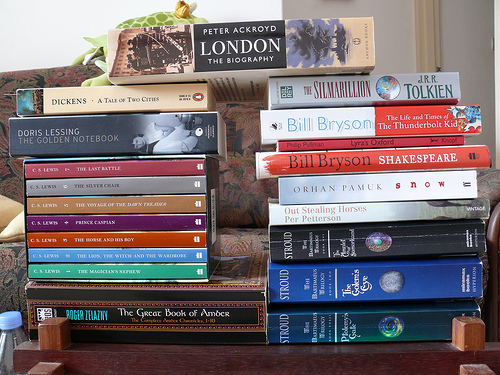
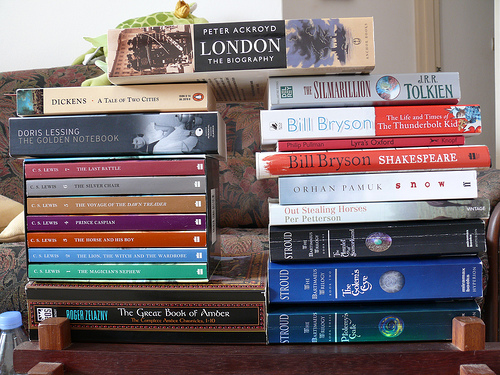
Stack of fiction books on a desk

5 Ways To Read 5 Books A Week

Stack of fiction books on a desk

I prefer non-fiction myself.

Great leaders take in a lot of information, and when you are just starting out with your passion you may find there is hardly any time to sit down and take in everything you need to know in order to launch your successful venture. Having no time is a limiting mindset that will hold you back. Fortunately reading books has gotten a lot simpler these days. Here are the 5 ways to read at least 5 books per week in order to maintain my edge and personal development.

Change Your Attitude About Reading 

First, you do not  have to read every word of a book to have successfully read it. While yes there are some books  worthy of being fully read, a lot of books will be perfectly useful if you use speed reading practices. Skim, scan,  and  trust your ability to understand concepts without reading every word.

Read on Your Way To Work

One of my favorite websites on the entire internet is my library’s e-book collection. Filled with a host of free e-books and audio books waiting to be taken in by any library card. Check out your library and see if they offer audio book options, which now can often be played through your smartphone. If not YouTube has an extensive collection of audiobooks as well.

Read before you clock in 

Always get to work half an hour early. In that half hour, you can change your world. Or if that’s not possible then the time before you clock in for lunch is another space of time to spend reading. Typically I set a ten-minute clock and go as far as I can. Progress will always be made with consistency.

Read during your downtime
If you are at work, there will be downtime. While I advocate using that downtime to be a better work, that could also include being a better leader, which is applicable in any industry or company. Once again go to your library’s website to see if they have electronic books. Another possibility is letting an audiobook play in the background in lieu of your awesome work playlist.

Read during chore time 
Unless you have a maid, you will have to do a chore or two. The point here is there are some weekly activities you naturally do, like the laundry, dishes, or whatever is going on in the fridge. Use the time to put an audiobook on in the background.

Always find ways to acquire more knowledge for that is the substance of creative thinking, which is the habit of success.

photo credit: Recent, present and future reading material via photopin (license)